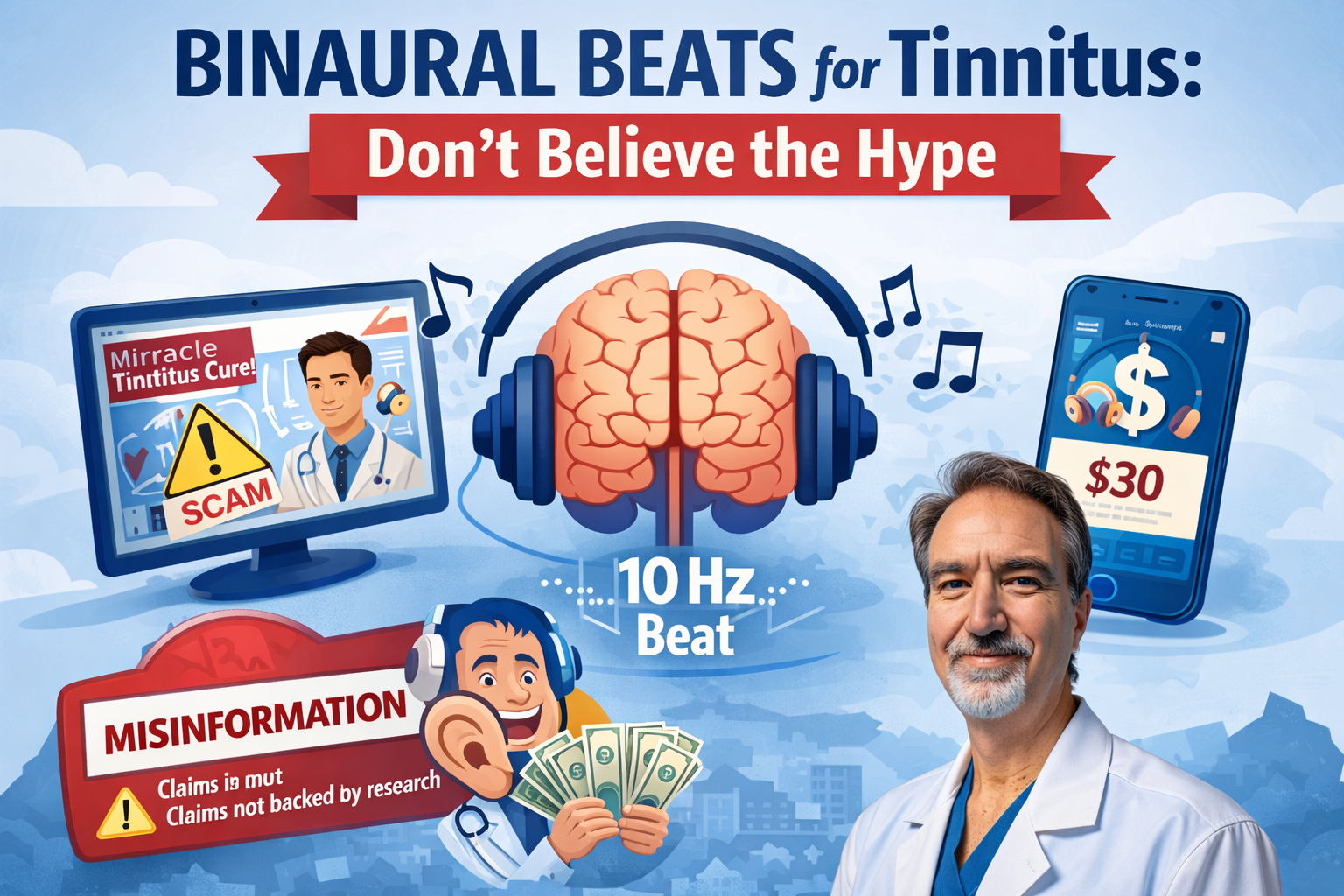
If you have tinnitus, you’ve probably seen videos promising fast relief with binaural beats. When the ringing keeps you awake at 3 a.m., those promises are tempting. I understand that. But let’s slow this down and look at what the research actually shows.
I've specialized in treating hearing loss and tinnitus for over 20 years and I’ve seen a lot of “miracle cures” come and go. Binaural beats are the latest one.
If you'd rather watch a video on YouTube click here.
Table of Contents
- What are binaural beats?
- Why binaural beats sound convincing
- Red flags to watch for online
- What the research really says
- Treatments with strong evidence
- My clinical advice
- Frequently Asked Questions
What are binaural beats?
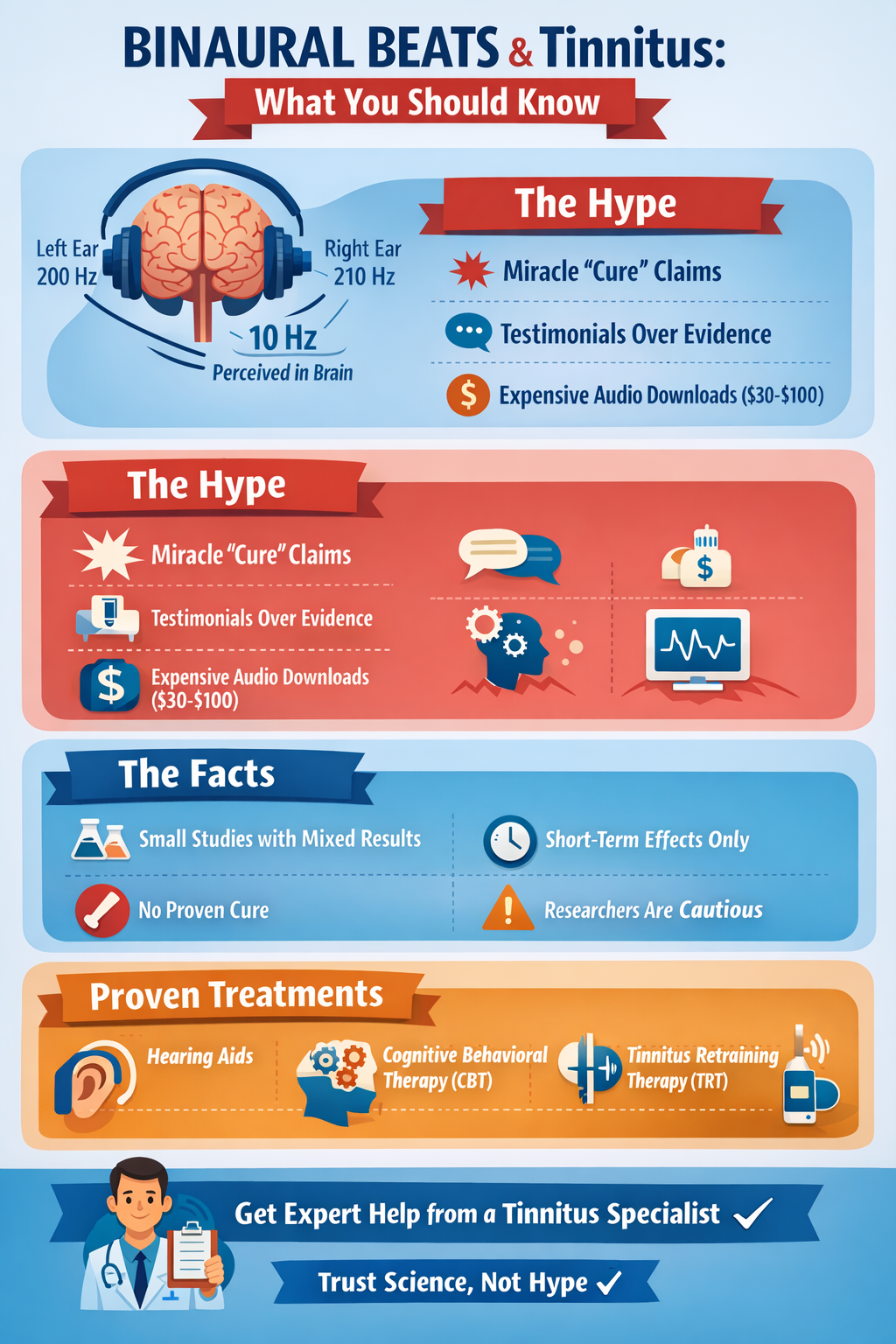
Binaural beats are an auditory illusion. When you listen to two slightly different tones—one in each ear—your brain perceives a third “beat” at the difference between them.
For example:
- Left ear: 200 Hz
- Right ear: 210 Hz
- Perceived beat: 10 Hz
This happens in the brainstem where signals from both ears meet. It’s a real neurological effect.
Why binaural beats sound convincing
Binaural beats are often linked to something called brainwave entrainment. The theory is that these beats can encourage certain brain states:
- Alpha waves for relaxation
- Theta waves for meditation
- Delta waves for sleep
The claim is that calming the brain might reduce tinnitus or help you “retrain” your auditory system. On paper, that sounds reasonable. And that’s exactly why these videos sell so well. But plausible does not mean proven.
Red flags to watch for online
When you see binaural beats marketed for tinnitus, there are some consistent warning signs.
- They promise a “cure.” There is no peer-reviewed evidence showing binaural beats cure tinnitus.
- They cherry-pick studies. Small pilot studies are quoted without mentioning their limitations.
- They rely on testimonials, not data. Personal stories are not the same as clinical evidence.
- They sell expensive audio files. Often $30–$100 for something freely available elsewhere.
- They misuse scientific language. Words like “neuroplasticity” are used without context.
When you search for tinnitus relief online, you’ll find everything from personal stories to “miracle cures.” Research by the NIH analyzing tinnitus content on Facebook, Twitter, and YouTube found various degrees of misinformation across all platforms, with many posts carrying inaccurate or unsupported claims.
What the research really says
To be fair, there are studies on binaural beats and tinnitus.
Some small trials have shown:
- Modest improvements in tinnitus distress scores
- Temporary reductions in perceived loudness
- Short-term changes in brain activity
But these studies also share major limitations:
- Very small sample sizes
- Short follow-up periods
- Inconsistent results
- Cautious conclusions from the researchers themselves
The bottom line is simple: binaural beats may help some people relax. Reduced stress can make tinnitus feel less intrusive. But that is very different from treating the underlying condition.
Treatments with strong evidence
If tinnitus is affecting your quality of life, the American Academy of Otolaryngology recommends these options because they have much stronger scientific support.
Hearing aids
About 90% of people with chronic tinnitus also have hearing loss. Properly fitted hearing aids can:
- Increase access to real-world sound
- Reduce auditory deprivation
- Mask tinnitus naturally
Studies suggest 60–80% of patients report some level of relief.
Cognitive Behavioral Therapy (CBT)
CBT doesn’t turn tinnitus off. It changes how your brain reacts to it. Large studies and meta-analyses show meaningful improvements in distress and quality of life. This approach is supported by groups like the American Academy of Otolaryngology–Head and Neck Surgery.
Tinnitus Retraining Therapy (TRT)
TRT combines sound therapy and counseling over time. The goal is habituation—teaching your brain that tinnitus is not a threat. It’s slow, but it helps many patients.
Bimodal neuromodulation
This is one of the most promising newer options. Devices like Lenire, developed by Neuromod Devices, combine sound with gentle tongue stimulation. Large controlled trials led to FDA clearance, with many users reporting meaningful improvement. This is what real clinical evidence looks like.
My clinical advice
Listening to binaural beats is unlikely to harm you. If you find them relaxing or helpful for sleep, that’s fine. Just don’t rely on them as your main treatment.
If tinnitus is interfering with your life, here’s what I recommend:
- See an audiologist who specializes in tinnitus care
- Look for providers with advanced training, such as credentials from the American Board of Audiology
- Ask about evidence-based options like hearing aids, CBT, TRT, or bimodal neuromodulation
Be cautious with anything marketed as a miracle cure. Your tinnitus is real, and you deserve care grounded in real science.
To learn more, visit our Learning Center or explore our Tinnitus Treatment Options. If you’re in Utah, you can also request a free consultation.
Frequently Asked Questions
Do binaural beats cure tinnitus?
No. There is no scientific evidence showing that binaural beats cure tinnitus. At best, they may reduce stress or annoyance for some people.
Can binaural beats make tinnitus worse?
For most people, no. However, if certain sounds increase your awareness of tinnitus, it’s reasonable to stop using them.
Are binaural beats the same as sound therapy?
No. Evidence-based sound therapy is personalized and often combined with counseling. Binaural beats are generic audio tracks.
What is the most effective treatment for tinnitus?
There is no single best treatment. Hearing aids, CBT, TRT, and newer neuromodulation approaches all have strong evidence, depending on the individual.
