
By Dr. Layne Garrett, Au.D., FAAA, ABAC, CH-TM, CDP (About | YouTube | Podcast | LinkedIn)
Date Published: February 9, 2026 3:30 PM
Your tinnitus probably gets worse when you're stressed. Maybe it's louder after a difficult workday. Perhaps that ringing won't let you sleep when something's weighing on your mind. For years, all I could tell patients was "yes, they seem connected"—but we couldn't measure it objectively.
That just changed.
If you'd rather watch than read, I break this down in a video here.
Table of Contents
- What the Apple-University of Michigan Study Found
- Understanding Heart Rate Variability
- Why This Connection Matters for Your Treatment
- The Problem with Outdated Tinnitus Care
- How Modern Centers Use HRV Monitoring
- When HRV Monitoring Helps Most
- What This Means If You're in Utah
- Frequently Asked Questions
What the Apple-University of Michigan Study Found
Researchers at the University of Michigan partnered with Apple on a groundbreaking study. They analyzed data from 72,229 people wearing Apple Watches over 60 days. This is likely the largest tinnitus study we've ever seen.
The findings confirmed what patients have told us for decades. There's a measurable connection between stress and tinnitus severity. Moreover, it's not just "it feels worse"—we can see it in objective data.
The Key Finding
People with more severe tinnitus had consistently lower heart rate variability. The worse someone's tinnitus affected their daily life, the more rigid their stress response became. Therefore, the pattern was clear across 72,000 people.
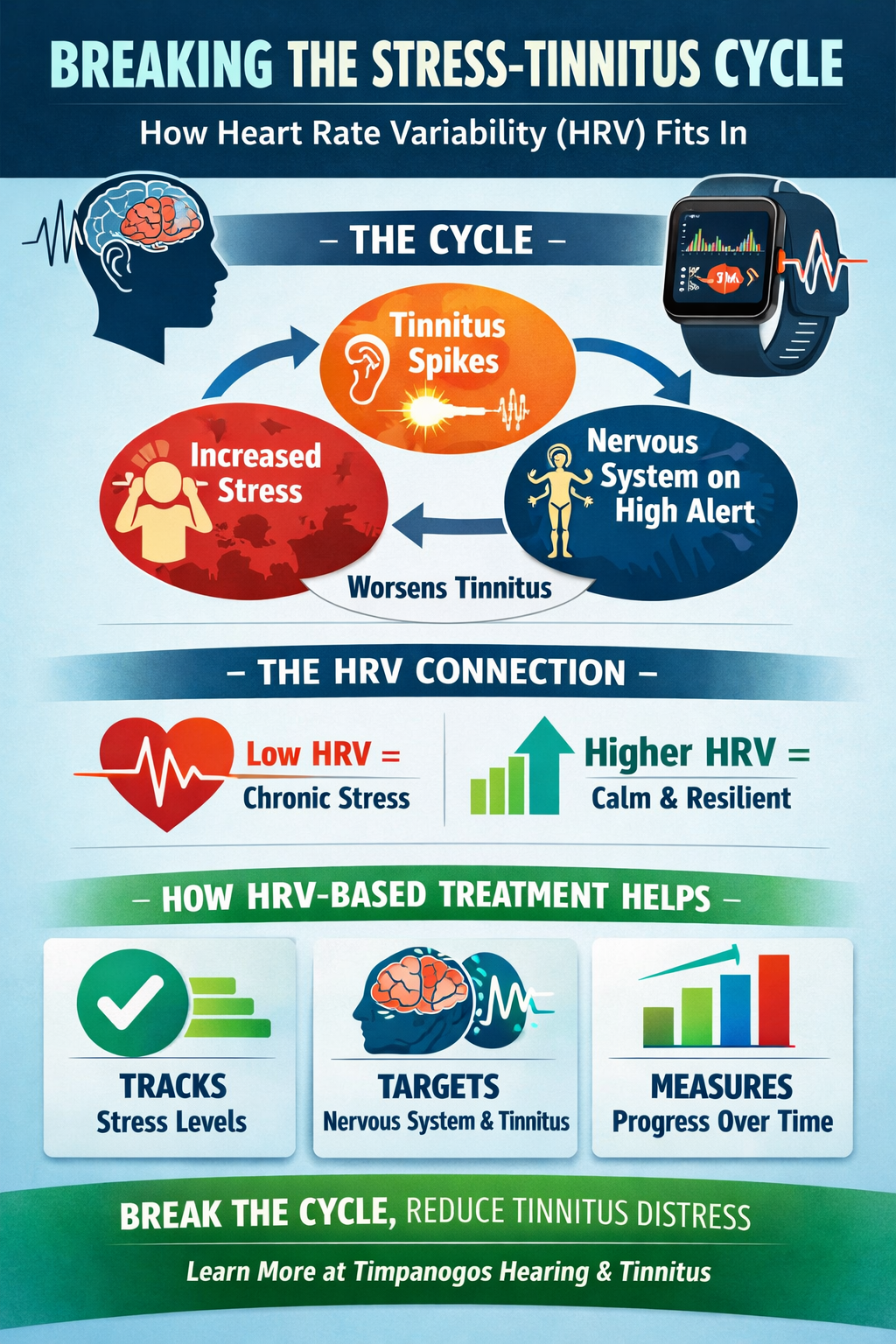
In our Utah clinics, patients who struggle most with tinnitus share one thing in common. They're caught in what researchers call a "self-perpetuating cycle." The tinnitus causes stress. That stress keeps their nervous system on high alert. Which makes them more aware of the tinnitus. Which causes more stress.
If you've experienced this yourself, you're not imagining it. In fact, the study confirmed that after noise exposure, stress is the second most common trigger for worsening tinnitus.
What Makes This Study Different
Previous research relied on small groups in controlled settings. However, this study captured real-world data from tens of thousands of people. Additionally, the Apple Watch measured heart rate variability automatically throughout each day—no special effort required.
The researchers were careful to note one thing. HRV gets affected by many factors—fitness level, sleep quality, even what you ate. But when you're looking at 72,000 people, those individual factors average out. What remains is a clear signal about the stress-tinnitus connection.
Understanding Heart Rate Variability
Let's clarify what heart rate variability actually measures. Most people have never heard of it. Nevertheless, understanding this concept is important for grasping how modern tinnitus treatment works.
You might think your heart beats like a metronome—perfectly steady. However, a healthy heart has natural variation in timing between beats.
How HRV Works
Consider this example. If your heart beats at 60 beats per minute, that doesn't mean exactly one second between each beat. Sometimes it might be 0.9 seconds. Sometimes 1.1 seconds. That little variation is your HRV—heart rate variability, or the changing time between heartbeats.
Here's what surprises people most. Higher variation is actually better for your health. When your HRV is higher, your nervous system functions well. You're more resilient. You bounce back from stress better.
What Low HRV Reveals
On the other hand, low HRV sends a different signal. When those heartbeats become mechanical and rigid, your nervous system is stuck in overdrive. Your body constantly runs that fight-or-flight response—even when there's no actual danger. This chronic stress state amplifies tinnitus perception.
The practical advantage is simple. Your Apple Watch or similar devices measure this automatically throughout the day. You don't even have to think about it.
Why This Connection Matters for Your Treatment
So why should you care about this research? There are three important reasons for anyone dealing with tinnitus.
It Validates Your Experience
First, it validates what you've probably experienced all along. If you've felt your tinnitus worsens with stress, you're not imagining it. There's measurable physiology behind it. Furthermore, we can now track this connection objectively.
It Opens New Treatment Approaches
Second, this understanding creates new intervention opportunities. If we can identify when your nervous system is chronically stressed—when your HRV stays consistently low—we can target specific treatments. Therefore, we're not just treating the noise in your ears. We're addressing one of the underlying mechanisms making it worse.
It Provides Objective Tracking
Third, it gives us a way to measure treatment effectiveness. Unlike tinnitus loudness, which is subjective and hard to measure consistently, HRV is objective data. Consequently, we can monitor your progress over time with real numbers.
The Clinical Pattern I See Most Often
This is where patients usually get misled by internet articles. Most tinnitus content focuses almost exclusively on the auditory system—hearing loss, cochlear damage, auditory processing. That's certainly part of the picture for many people.
However, what I've observed over 20 years differs from this narrow focus. Patients with similar hearing loss profiles can have wildly different tinnitus experiences. One person barely notices it. Another is completely debilitated. The difference almost always comes down to nervous system stress response.
When we measure HRV in our clinic, we frequently see something surprising. Patients with severe tinnitus distress have low HRV even when they're not consciously feeling stressed. In other words, their body is stuck in chronic stress mode—they've just become so accustomed to it that they don't recognize it anymore.
The Problem with Outdated Tinnitus Care
Let me be direct about something that frustrates me almost daily. A lot of available tinnitus treatment is wildly outdated.
What Outdated Care Looks Like
You Google tinnitus help and you're hit with predictable advice. "Try ginkgo biloba." "Listen to white noise apps." Or my personal least-favorite—"just learn to live with it." Seriously?
To be blunt: if a provider tells you there's nothing they can do except suggest white noise, they're at least a decade behind. That's not acceptable care in 2026. This is where I draw the line professionally.
I had a patient last month who'd been struggling for three years. Her previous provider gave her a generic handout about masking sounds. Then he sent her home. There was no comprehensive testing. He offered no treatment plan. She received no explanation of the stress-tinnitus cycle. Just "good luck."
That's not treatment. That's dismissal. And you deserve better than that.
What Modern Evidence-Based Care Includes
What we're doing now looks completely different. We measure HRV to track nervous system patterns. Sound therapy gets tailored based on real data from your specific case. Bimodal neuromodulation becomes part of treatment when appropriate. Moreover, all of this is grounded in neuroscience and supported by large-scale studies like the Apple-University of Michigan research.
The difference between adequate care and comprehensive care comes down to one question. Are you addressing just the auditory symptoms? Or are you treating the whole picture including nervous system regulation?
If your provider isn't asking about stress levels, sleep quality, or autonomic nervous system function, they're missing critical pieces. Consequently, your treatment is incomplete before it even starts.
How Modern Centers Use HRV Monitoring
At Timpanogos Hearing & Tinnitus, we've invested in technology and training for HRV monitoring. This is part of comprehensive tinnitus treatment. We're not doing the old-school approach of just fitting hearing aids and sending you home.
The Foundation: Proper Hearing Aid Fitting
Don't get me wrong about one thing. Properly fitted hearing aids with Real Ear Measurement verification are absolutely essential for effective tinnitus management. However, that's just the foundation. We're looking at the whole picture beyond just amplification.
Integrating HRV Into Treatment
For some patients, we recommend combining sound therapy with specific stress management techniques. These techniques are designed to improve HRV over time. For others, we track HRV data across weeks and months. This shows us how different treatments affect nervous system regulation.
We also offer bimodal neuromodulation devices like Lenire. These work by helping retrain how your brain responds to tinnitus signals. When we combine these evidence-based treatments with HRV monitoring, we create truly personalized plans. Therefore, you're not getting generic advice—you're getting targeted intervention.
The Real Goal
The goal isn't just to turn down the volume on your tinnitus. That's certainly part of it. But the bigger goal is breaking that stress-tinnitus cycle we discussed earlier. Additionally, we're helping your nervous system get out of constant fight-or-flight mode. Ultimately, we're improving your overall quality of life—not just reducing ringing.
When HRV Monitoring Helps Most
Here's where clinical experience becomes important. Not every tinnitus patient needs HRV monitoring as part of their treatment plan. So how do we decide?
Strong Indicators for HRV Monitoring
HRV monitoring is most valuable in these situations:
- Your tinnitus fluctuates significantly with stress levels. If you've noticed clear patterns—worse during work deadlines, better on vacation, terrible during family conflicts—that's a strong signal. Nervous system regulation is playing a major role.
- You have normal or near-normal hearing but severe tinnitus distress. This is where people get misled most often. They assume tinnitus always comes from hearing damage. Sometimes it does. But when hearing tests come back normal and tinnitus is still debilitating, stress response usually drives the problem.
- Previous treatments haven't worked despite good compliance. If you've tried hearing aids or sound therapy consistently for several months without improvement, something's been missed. Frequently, it's the stress-tinnitus cycle that wasn't addressed.
When HRV Monitoring Usually Isn't the Primary Focus
On the other hand, mild intermittent tinnitus that doesn't impact daily life probably doesn't need intensive HRV work. Basic sound therapy and hearing aid fitting (if you have hearing loss) will likely suffice.
Similarly, if your tinnitus started immediately after clear acoustic trauma—gunshot, explosion, very loud concert—and you have significant hearing loss, auditory rehabilitation should be our primary focus initially. We can always add nervous system regulation later if needed.
The Pattern That Predicts Success
The pattern that typically predicts when HRV monitoring will help most includes these factors:
- Chronic tinnitus present for 6+ months
- High distress scores on standardized questionnaires
- Sleep disruption related to tinnitus
- Identifiable stress triggers
Those four factors together? That's when integrating HRV data usually makes a substantial difference in outcomes.
When Treatment Fails Despite HRV Work
This is where clinical judgment matters most. When HRV-informed treatment doesn't help, it's almost always one of three things:
First: The patient isn't actually implementing the stress management techniques consistently. Reading about breathing exercises isn't the same as doing them daily for 8-12 weeks. Compliance matters enormously with nervous system retraining.
Second: There's an underlying psychological component that needs professional mental health treatment beyond what an audiologist can provide. Severe anxiety, depression, or PTSD requires coordination with psychology or psychiatry.
Third: The tinnitus has a different primary mechanism we haven't identified yet. Maybe it's medication-related, vascular, or related to TMJ dysfunction. Therefore, further diagnostic work is needed.
What This Means If You're in Utah
The Apple-University of Michigan study represents a significant step forward. For decades, we've known stress and tinnitus go hand in hand. Now we have tools to measure that connection objectively. Moreover, we can intervene effectively based on that data.
Setting Realistic Expectations
Here's the realistic expectation I want to set clearly. HRV monitoring isn't a magic cure. It's one component of comprehensive, evidence-based tinnitus treatment. However, when it's integrated properly with sound therapy, counseling, and appropriate devices, it can substantially improve outcomes.
Over my years in practice, I've learned one thing. Patients who understand what treatment can and can't do have better results than those expecting miracles. Therefore, let me be clear: we're targeting significant reduction in tinnitus distress and perception. Complete elimination happens sometimes but isn't guaranteed.
Availability of Comprehensive Treatment in Your Area
If you're in Northern Utah comprehensive tinnitus treatment with HRV monitoring is available locally.
Our clinics in American Fork and Spanish Fork specialize in evidence-based tinnitus treatment. Our providers hold specialized tinnitus management certification. We offer the full range of modern approaches. This includes HRV-informed treatment planning, Cognitive Behavioral Therapy education, hearing aids, bimodal neuromodulation (Lenire), and tinnitus retraining therapy.
Timing Matters for Better Outcomes
Over 20 years in practice, the pattern I see most consistently is this. Patients who get comprehensive evaluation and treatment within the first 6-12 months of tinnitus onset typically have much better outcomes. Those who wait years while trying ineffective approaches struggle more. The stress-tinnitus cycle becomes more entrenched over time. Consequently, early intervention matters significantly.
When You're Ready to Explore Your Options
Schedule your free consultation - we'll evaluate your specific situation and explain what the research shows for cases like yours. Additionally, we'll discuss what evidence-based treatment options make sense for your needs. Most patients tell us the clarity they get about their tinnitus is worth the appointment alone.
Or call us at (385) 332-4325 - speak with our team directly about your concerns. Ask what to expect from a comprehensive tinnitus evaluation.
Want to do more research first? Visit our Learning Center for detailed information. You'll find articles about tinnitus causes, treatment options, and what modern evidence-based care actually looks like.
Frequently Asked Questions
Do I need an Apple Watch to get HRV-informed tinnitus treatment?
No, you don't need any specific device. While consumer wearables like Apple Watch make HRV data more accessible, we can measure HRV in our clinic during appointments. If you already wear a device that tracks HRV, that data can be helpful. However, it's not required for treatment.
Will improving my HRV make my tinnitus go away completely?
Probably not, and I need to be honest about that expectation. HRV monitoring helps us address the stress-tinnitus cycle. This can significantly reduce tinnitus distress and perception. However, if there's underlying hearing damage or other physiological factors, those still need separate treatment. Think of HRV work as one important piece—not a standalone cure.
How long does it take to see improvement from HRV work?
In our clinic, patients working on nervous system regulation typically notice some improvement within 4-8 weeks. However, breaking a deeply entrenched stress-tinnitus cycle can take several months. The good news? Improvements in sleep quality and overall stress resilience often show up before tinnitus reduction does. Therefore, you'll know the treatment is working even if tinnitus perception hasn't fully improved yet.
Is HRV monitoring covered by insurance?
HRV monitoring itself isn't typically billed separately. It's integrated into comprehensive tinnitus evaluation and treatment planning. This may be partially covered depending on your insurance plan. We'll go over your specific coverage and out-of-pocket costs during your consultation. Therefore, you'll have complete financial clarity before starting treatment.
What if I have hearing loss AND stress-related tinnitus?
That's actually very common in our patient population. Most people we see have both components contributing to their tinnitus. The treatment approach addresses both simultaneously. We use properly fitted hearing aids with Real Ear Measurement for the hearing loss. Additionally, we add stress management and HRV-informed interventions for the nervous system component. They work together synergistically rather than competing.
About the Author
Dr. Layne Garrett, Au.D., FAAA, ABAC, CH-TM, CDP is the founder of Timpanogos Hearing & Tinnitus.
Links: About | YouTube | Podcast | LinkedIn
Reviewed/Edited By
Modified by: Dr. Layne Garrett, Au.D., FAAA, ABAC, CH-TM, CDP
Date: February 9, 2026 3:30 PM
