What if the answer to your tinnitus wasn’t hiding in your ears at all—what if it was right on your tongue?
Patients often look at me like I’ve lost my mind when I tell them we’re going to zap their tongue to treat tinnitus… until they see the results.
For years, millions of people have been told, “There’s nothing you can do—just live with it.” Meanwhile, the ringing, buzzing, or hissing keeps stealing sleep, focus, and peace of mind. At Timpanogos Hearing & Tinnitus, we’ve helped thousands of people in Utah County, from American Fork to Spanish Fork, who thought they had no options. Today, there finally is one—an FDA-approved device called Lenire.
Table of Contents
- What Makes Tinnitus So Hard to Treat
- Meet Lenire: A New Kind of Therapy
- How Zapping Your Tongue Helps Your Brain
- The Research and What I See in My Clinic
- Real-World Results
- Is Lenire Right for You?
- Who Is Lenire For? (Quick Chart)
- Thomas’s Story
- Take the Self-Assessment
- FAQs
What Makes Tinnitus So Hard to Treat
Tinnitus isn’t a disease—it’s a symptom. More than 25 million U.S. adults hear phantom ringing, buzzing, or hissing. Some can live with it. Others find it devastating, especially at bedtime when quiet makes the sound louder.
For years, the advice was: “Mask it with a fan” or “learn to ignore it.” That left many people chasing supplements or internet “cures” that didn’t help.
Want to watch this review instead of read it? Watch Here.
Meet Lenire: A New Kind of Therapy
In March 2023, Lenire became the first—and only—device to receive De Novo FDA approval for tinnitus treatment.
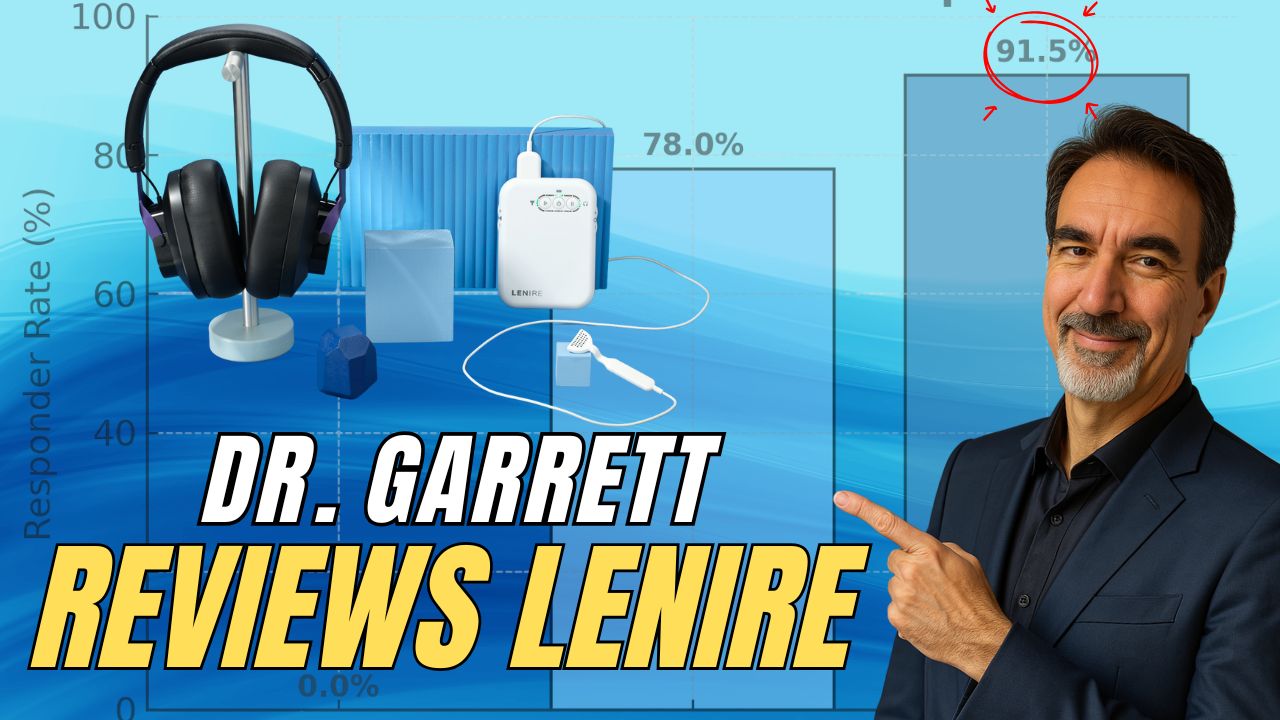
It has three parts: Bluetooth headphones, a handheld controller, and the Tonguetip—a small paddle that rests on your tongue.
Lenire uses bimodal neuromodulation: sound in the ears and gentle electrical pulses on the tongue. The key insight is that tinnitus is not really an ear problem—it’s a brain problem.
How Zapping Your Tongue Helps Your Brain
When the brain loses sound input (often due to hearing loss), it sometimes “fills in the blanks” with phantom noise.
Lenire retrains the brain using neuroplasticity. The headphones deliver sound therapy while the Tonguetip delivers gentle pulses—patients describe it like champagne bubbles or Pop Rocks.
This dual input makes the brain pay attention in a new way, disrupting the tinnitus loop. Over time, the phantom noise becomes less intrusive.

Image: The Lenire device includes headphones, a controller, and the Tonguetip
The Research and What I See in My Clinic
The TENT-A3 clinical trial showed that 70.5% of people who didn’t respond to sound therapy improved once tongue stimulation was added. Nearly 80% saw meaningful relief, and almost 89% said they’d recommend it.
In my own practice, those numbers hold true. I’ve seen patients who spent years frustrated finally sleep better, focus at work, and stop thinking about tinnitus all day.
Real-World Results
A U.S. study of 220 patients found that after 12 weeks, 91.5% had a clinically meaningful improvement.
Not everyone gets total silence, but most get something just as valuable: the ability to ignore the noise without effort.
Is Lenire Right for You?
Lenire is a prescription device, and it’s not one-size-fits-all. At Timpanogos Hearing & Tinnitus, we use it as part of a customized treatment plan that may also include:
- Hearing aids to restore missing sound input
- Cognitive Behavioral Therapy (CBT)
- Lifestyle changes to reduce stress, improve sleep, and support brain health
- Tinnitus Retraining Therapy (TRT)
- Biometric monitoring to track progress
A complete evaluation is the first step.
At our clinic, the investment is $375 per month (12 months OAC) or $4,500. This includes one year of testing, treatment, counseling, the Lenire technology, My Tinnitus Therapy, and biometric monitoring if needed.
Learn more about other tinnitus treatment options.
Who Is Lenire For? (Quick Chart)
(Save or screenshot this for reference.)
| Best Candidates | Not a Fit / Defer for Now |
| Tried other treatments without enough relief | Can’t commit to two 30-minute sessions daily |
| THI ≥ 38 (take the self-assessment) | THI < 38 on self-assessment |
| Ready to commit to 2×30 minutes/day for up to 12 weeks | Looking for “set-and-forget” or occasional use |
| No contraindications (see right) | Any of the following contraindications: |
| — | Active implants (pacemaker/defibrillator/other active implantable device) |
| — | Pregnancy |
| — | Epilepsy or conditions with loss of consciousness |
| — | Tongue numbness/sensitivity disorders |
| — | Oral sores/lesions or active inflammation |
| — | Head/neck neuralgia |
| — | Ménière’s disease (not evaluated) |
| — | Objective tinnitus (identified physical source) |
| — | Oral piercings |
Quick note: this is a general guide. Final candidacy is determined during your evaluation.
Thomas’s Story
One patient, Thomas Wayne Newman, faced an exceptionally severe form of tinnitus. His symptoms weren’t just ringing—they felt like buzzing in his brain and “electrical shocks” in his head.
He told me, “My tinnitus, I think, was more severe than most people’s. I also had problems not only with my ears, but up in my head, used to get electrical shocks. I’ve come to this office and they are gone.”
Like many, Thomas worried there was no real solution. “The fear of not being able to get my tinnitus taken care of because they say there’s no cure for tinnitus… but I’ll tell you what, we’ve come pretty close with this therapy. It’s incredible.”
Within just two days of starting Lenire, he felt about 50% better. The biggest change? Clear thinking without constant buzzing.
He summed it up beautifully: “I am a happy man again. I used to struggle with that. Now my doctor has made me a happy man.”
🎥 Watch Thomas share his story in his own words:
Watch on YouTube
Conclusion
For too long, tinnitus care has been about frustration. With Lenire—and a modern, multifaceted approach—we now have real solutions backed by science and patient stories.
If you’ve ever been told “there’s nothing you can do”—please hear this: that’s just not true anymore. Request your free consultation and find out if Lenire could finally bring the peace and silence you deserve.
You can also explore our Learning Center for resources, guides, and expert insights.
And if you know someone struggling with tinnitus, please share this article with them—you might help them take the first step toward relief.
Take the Self-Assessment
Not sure if Lenire or another therapy is right for you? Start with our quick Tinnitus Self-Assessment. It only takes a few minutes and gives you a clearer picture of your tinnitus and next steps for care.
FAQs
Is Lenire FDA-approved?
Yes. In 2023, Lenire became the first tinnitus device to receive De Novo FDA approval.
Does Lenire cure tinnitus completely?
Not always. Some people get total silence, but most find the noise becomes far less noticeable.
How long does it take to see results?
Most patients report improvement after 6–12 weeks of consistent use.
Is Lenire covered by insurance?
Usually not, but HSA and FSA funds can often be used.
Do you offer other tinnitus treatments?
Yes. We also provide CBT, hearing aids, TRT, and other evidence-based options.
